
How AI Agents Are Changing Customer Support Operations in 2026
Discover how AI agents are transforming customer support operations in 2026 through intelligent automation, faster response times, reduced support costs, and scalable 24/7 customer experiences for startups and enterprises.
Vayqube Team
Author
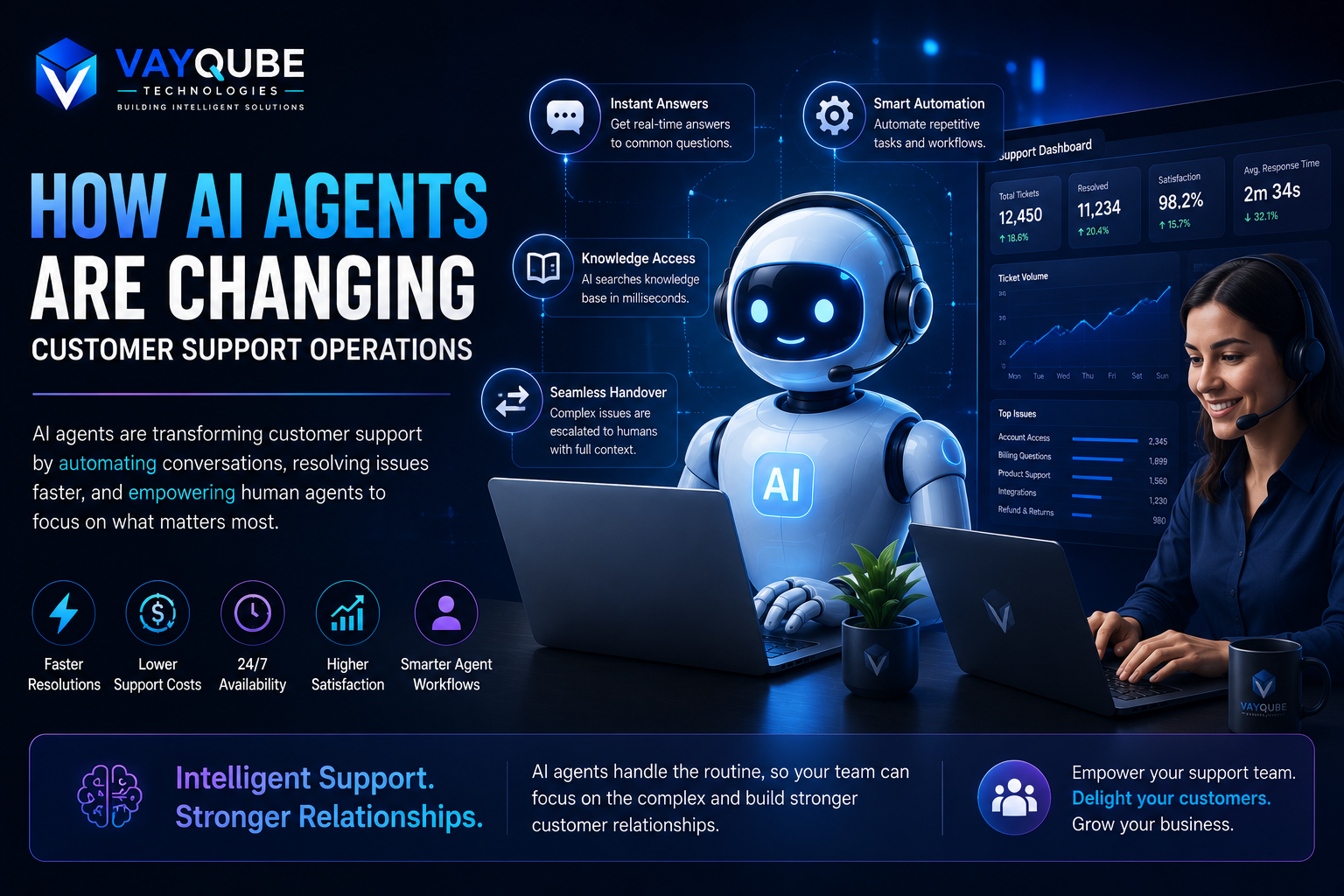
How AI Agents Are Changing Customer Support Operations
Customer expectations in 2026 are higher than ever. Users expect instant responses, personalized assistance, 24/7 availability, and consistent support across websites, mobile apps, email, chat, and social platforms. At the same time, businesses are struggling with rising support costs, overloaded support teams, slower response times, and operational inefficiencies.
Traditional customer support systems often rely heavily on manual workflows where agents spend hours answering repetitive questions, searching for customer history, updating tickets, escalating issues, and coordinating between departments. As companies scale, these operational bottlenecks become even more expensive.
This article is designed for founders, CTOs, support managers, SaaS companies, and enterprise teams evaluating how AI agents can improve customer support operations. You will learn how AI-driven support systems work, where businesses are seeing the biggest operational gains, implementation challenges to consider, and how modern support teams are combining automation with human assistance to create faster and more scalable customer experiences.
Quick Summary
- AI agents are helping businesses automate repetitive support workflows, improve response speed, reduce operational costs, and deliver more personalized customer experiences.
- The biggest business impact comes from faster ticket resolution, lower support overhead, better customer satisfaction, and scalable 24/7 support operations.
- Before deploying AI support systems, businesses should first identify repetitive support workflows, customer pain points, and integration requirements with existing systems.
What Teams Should Evaluate First
| Area | What to check | Why it matters |
|---|---|---|
| Business goal | Revenue, efficiency, risk reduction, user experience | Keeps the article tied to real outcomes |
| Users | Founders, CTOs, operations, sales, customers | Makes examples more relevant |
| Technology | Stack, integrations, data, security | Helps readers understand implementation tradeoffs |
| Delivery | Timeline, team, QA, launch, support | Prevents thin advice and makes the article actionable |
Main Section One
Why Traditional Customer Support Models Are Becoming Difficult to Scale
As businesses grow, customer support volume increases rapidly. Support teams must manage onboarding questions, technical issues, billing requests, account management, complaints, escalation handling, and operational coordination across multiple channels.
Traditional support systems usually involve:
- Manual ticket routing
- Repetitive customer queries
- Slow response times
- Human dependency for basic workflows
- Fragmented support data
- High operational costs
This creates several business problems:
- Longer wait times
- Agent burnout
- Inconsistent customer experience
- Higher staffing costs
- Reduced customer retention
- Slower operational scalability
AI agents are helping businesses solve these problems by automating repetitive support operations while allowing human agents to focus on complex or sensitive issues.
What AI Support Agents Actually Do
Modern AI support agents are much more advanced than basic chatbots.
Instead of only responding with pre-defined scripts, AI agents can:
- Understand natural language
- Retrieve customer history
- Search knowledge bases
- Summarize conversations
- Escalate complex issues
- Generate replies
- Analyze customer sentiment
- Automate workflows
- Integrate with CRM and ticketing systems
For example:
A customer asking about a delayed payment can receive:
- Real-time account verification
- Transaction status updates
- Automated troubleshooting
- Escalation if required
—all without waiting for a manual support agent.
Practical Steps
- Identify repetitive support requests consuming the most team hours.
- Organize support documentation, FAQs, and knowledge base content.
- Integrate AI agents with CRM, ticketing, and communication systems.
- Create escalation workflows for sensitive or high-priority issues.
- Monitor AI responses continuously to improve accuracy and reliability.
Main Section Two
How AI Agents Improve Customer Experience and Operational Efficiency
The biggest advantage of AI support systems is not simply automation — it is operational scalability combined with better customer experience.
Businesses using AI agents are improving:
- First response times
- Ticket resolution speed
- Customer satisfaction
- Support availability
- Internal productivity
- Operational efficiency
24/7 Customer Support Without Linear Hiring
Traditional support operations scale linearly with team size.
More customers usually mean:
- More support staff
- Higher operational costs
- Increased management complexity
AI agents reduce this dependency by handling a large percentage of repetitive conversations automatically.
This allows businesses to:
- Scale globally
- Support multiple time zones
- Reduce response delays
- Improve availability without massive hiring
AI Agents Also Help Human Support Teams
One common misconception is that AI agents completely replace support teams.
In reality, the best implementations combine:
- AI automation
- Human oversight
- Escalation workflows
AI handles repetitive operational tasks while human agents focus on:
- High-value conversations
- Complex technical issues
- Customer retention
- Sensitive escalation handling
This hybrid approach improves both operational efficiency and customer trust.
Challenges Businesses Must Consider
AI support systems still require careful planning.
Businesses must evaluate:
- Data privacy
- Customer authentication
- Integration complexity
- Hallucination prevention
- Access permissions
- Monitoring systems
- Compliance requirements
Poorly implemented AI support can damage customer trust instead of improving it.
That is why modern AI support systems require proper architecture, monitoring, and operational governance.
Practical Example
Imagine a growing SaaS company receiving thousands of monthly support requests related to onboarding, billing, integrations, password resets, and feature usage.
Previously:
- Support agents manually answered repetitive queries
- Response times increased during peak hours
- Customers waited longer for resolutions
- Internal coordination slowed operations
The company later implemented AI-powered support agents integrated with:
- CRM systems
- Ticketing platforms
- Product documentation
- User account data
- Billing systems
The AI system automatically:
- Answered common support questions
- Retrieved account information
- Generated ticket summaries
- Escalated critical issues
- Assisted human support agents
As a result:
- First response time improved significantly
- Operational workload reduced
- Customer satisfaction increased
- Support scalability improved without large hiring costs
A similar operational workflow can be seen in platforms like the CRM Dashboard, where centralized business systems and intelligent automation improve customer operations and workflow management.
Related Vayqube Resources
FAQ
Are AI agents replacing customer support teams completely?
No. Most businesses use AI agents to automate repetitive support workflows while human agents manage complex conversations, escalations, and customer relationship handling. The most successful support operations combine automation with human oversight.
What types of support tasks can AI agents automate?
AI agents can automate ticket categorization, FAQ responses, account lookups, onboarding assistance, workflow routing, conversation summaries, follow-ups, and basic troubleshooting. More advanced systems can also integrate with CRM, billing, and operational platforms.
Is AI customer support suitable for startups?
Yes. Startups often benefit significantly because AI support systems reduce operational workload and allow smaller teams to handle larger customer volumes efficiently. Many businesses start with limited AI automation and expand capabilities gradually.
Next Step
Customer support is rapidly evolving from manual ticket handling toward intelligent, AI-driven operational systems. Businesses that combine AI automation with strong support workflows are improving scalability, reducing operational costs, and delivering faster customer experiences.
If your business is evaluating AI-powered customer support systems, intelligent automation, or scalable operational infrastructure, the next step is to talk to a Vayqube solution architect.