
AI Copilots vs Traditional SaaS: What Businesses Actually Need in 2026
Discover the difference between AI copilots and traditional SaaS platforms in 2026. Learn which approach helps businesses improve automation, productivity, scalability, and operational efficiency while reducing manual workflows and software complexity.
Vayqube Team
Author
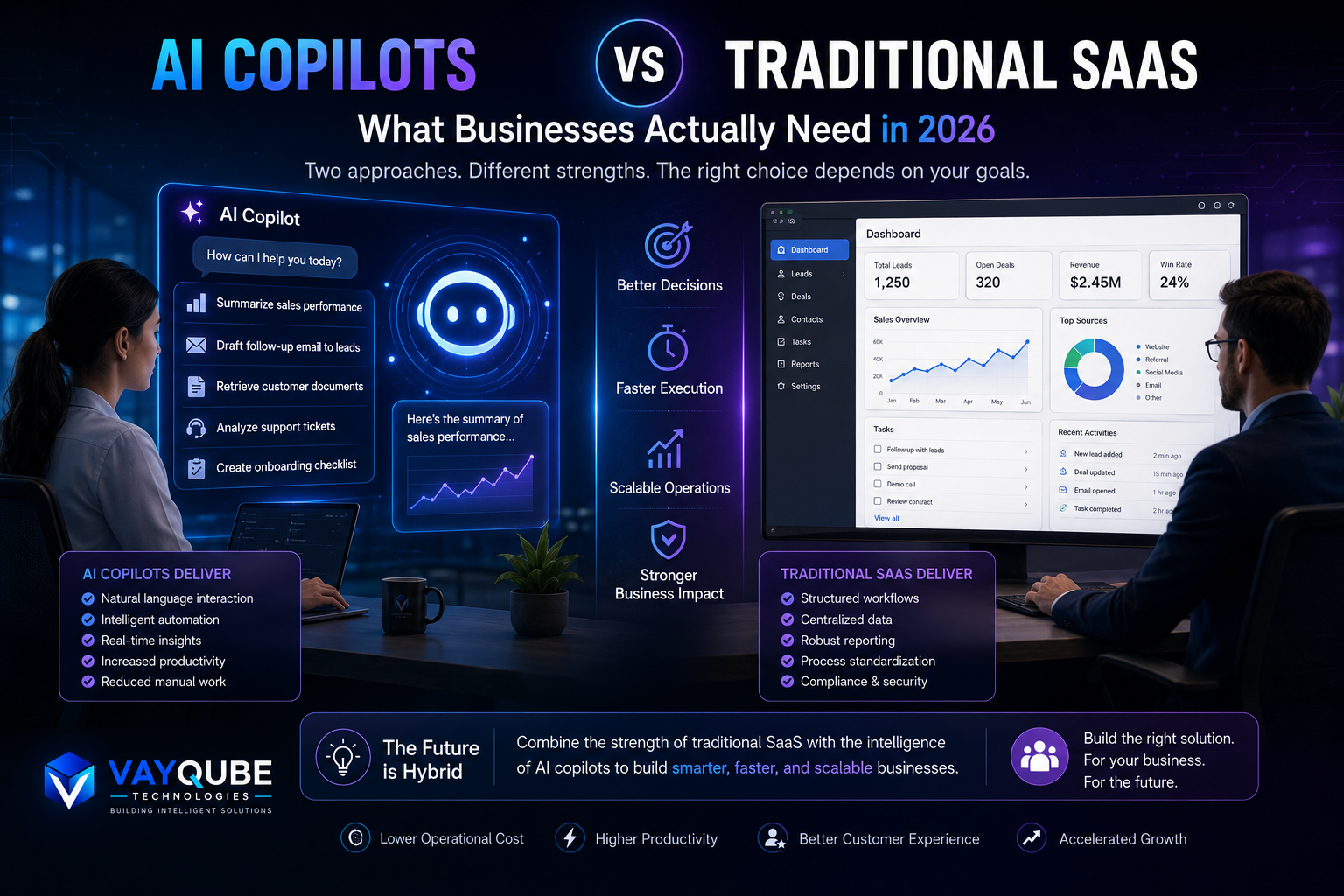
AI Copilots vs Traditional SaaS: What Businesses Actually Need
Businesses in 2026 are no longer asking whether they should adopt AI — they are asking how AI should fit into their products, operations, and customer workflows. This shift has created a growing debate between AI copilots and traditional SaaS platforms.
Many companies already use SaaS tools for CRM, support, finance, HR, analytics, and operations management. But teams are increasingly frustrated by fragmented workflows, manual processes, information overload, and complex interfaces that still require heavy human coordination.
AI copilots promise a different experience. Instead of forcing users to navigate dashboards manually, copilots can assist users conversationally, automate repetitive tasks, retrieve business data instantly, generate insights, and improve operational efficiency.
This article is designed for founders, CTOs, product leaders, and enterprise decision-makers evaluating whether their business should continue investing in traditional SaaS systems, adopt AI copilots, or combine both approaches. You will learn where each model works best, the business tradeoffs involved, and how companies are evolving toward AI-native operational systems.
Quick Summary
- Traditional SaaS platforms remain essential for structured business operations, while AI copilots improve productivity, automation, and user interaction on top of those systems.
- The biggest business impact comes from faster execution, lower operational overhead, improved employee efficiency, and better customer experiences.
- Businesses should evaluate whether they need operational systems, intelligent assistance, or a hybrid architecture that combines both.
What Teams Should Evaluate First
| Area | What to check | Why it matters |
|---|---|---|
| Business goal | Revenue, efficiency, risk reduction, user experience | Keeps the article tied to real outcomes |
| Users | Founders, CTOs, operations, sales, customers | Makes examples more relevant |
| Technology | Stack, integrations, data, security | Helps readers understand implementation tradeoffs |
| Delivery | Timeline, team, QA, launch, support | Prevents thin advice and makes the article actionable |
Main Section One
Why Traditional SaaS Still Matters
Traditional SaaS platforms are built around structured workflows, centralized data management, reporting systems, permissions, integrations, and operational control. These platforms became the backbone of modern businesses because they standardized how teams manage operations.
Examples include:
- CRM platforms
- HR management systems
- ERP software
- Accounting platforms
- Project management tools
- Customer support systems
Traditional SaaS works well because businesses need predictable workflows, reliable reporting, compliance management, audit trails, and centralized operational visibility.
For example:
A finance team cannot rely purely on conversational AI to manage accounting operations. They still require transaction systems, permissions, reconciliation processes, reporting dashboards, and compliance infrastructure.
Similarly, enterprise operations require structured databases, process tracking, workflow approvals, and system governance.
The Problem with Traditional SaaS
While SaaS platforms solved many operational challenges, they also introduced new problems:
- Too many dashboards
- Complex workflows
- Repetitive manual actions
- Slow onboarding
- Information fragmentation
- High operational overhead
- Employee productivity loss
Teams spend significant time searching for information, updating systems, generating reports, and navigating software instead of focusing on business outcomes.
This is where AI copilots are changing the experience.
Practical Steps
- Identify workflows where employees spend excessive time navigating systems manually.
- Audit repetitive operational tasks across departments.
- Evaluate where conversational interfaces or intelligent automation can improve efficiency.
- Keep critical operational systems stable while adding AI layers gradually.
- Prioritize copilots for internal productivity before replacing core systems.
Main Section Two
How AI Copilots Are Changing Business Operations
AI copilots are not replacing SaaS entirely — they are transforming how users interact with software.
Instead of forcing employees to manually search dashboards, generate reports, update CRM fields, or retrieve documents, AI copilots act as intelligent operational assistants layered on top of business systems.
For example:
- A sales copilot can summarize leads, generate follow-ups, update CRM records, and recommend next actions.
- A finance copilot can analyze transactions, generate reports, and answer operational questions.
- A support copilot can retrieve customer history, summarize tickets, and automate responses.
- An HR copilot can onboard employees, answer policy questions, and automate documentation workflows.
The key difference is interaction.
Traditional SaaS relies heavily on forms, menus, dashboards, and manual workflows.
AI copilots rely on natural language, contextual understanding, workflow orchestration, and intelligent automation.
Why Businesses Are Moving Toward Hybrid Systems
Most businesses in 2026 are not replacing SaaS platforms completely.
Instead, they are building hybrid operational architectures where:
- SaaS handles structured operational systems
- AI copilots improve workflow execution and productivity
This model provides the best balance between governance and automation.
AI Copilot Benefits
Businesses adopting AI copilots are seeing improvements in:
- Employee productivity
- Faster onboarding
- Reduced manual work
- Better response times
- Operational scalability
- Customer experience
- Decision-making speed
However, copilots also introduce challenges:
- Data security concerns
- AI hallucinations
- Access permissions
- Integration complexity
- Monitoring requirements
- Compliance risks
This is why successful AI implementations require strong architecture, governance, and operational visibility.
Practical Example
Imagine a fast-growing SaaS company managing customer onboarding, sales operations, support workflows, and reporting through multiple disconnected tools.
Previously, employees manually:
- Updated CRM records
- Generated reports
- Retrieved customer history
- Coordinated onboarding tasks
- Answered repetitive internal questions
The company later introduced an AI copilot connected to its CRM, internal documentation, support systems, and analytics platform.
The copilot allowed employees to:
- Ask operational questions conversationally
- Generate customer summaries instantly
- Automate repetitive updates
- Reduce time spent navigating dashboards
- Improve response speed across departments
At the same time, the business continued using structured SaaS systems for permissions, reporting, compliance, and workflow management.
This hybrid operational model is similar to platforms like the CRM Dashboard, where centralized systems and intelligent workflows work together to improve scalability and operational efficiency.
Related Vayqube Resources
FAQ
Are AI copilots replacing SaaS platforms completely?
No. Most businesses still require structured operational systems for reporting, permissions, compliance, and workflow management. AI copilots are typically layered on top of SaaS systems to improve productivity and automation rather than fully replace them.
What businesses benefit most from AI copilots?
Businesses with repetitive workflows, high operational coordination, customer support operations, sales teams, and large knowledge systems often see the biggest benefits. AI copilots are especially valuable when employees spend significant time searching for information or performing repetitive tasks.
Is building an AI copilot expensive?
The cost depends on architecture complexity, integrations, data infrastructure, and scalability requirements. Many startups begin with focused copilots connected to existing systems before expanding into broader AI automation platforms.
Next Step
Businesses no longer need to choose between AI copilots and traditional SaaS platforms entirely. The most scalable approach is usually a hybrid system where operational infrastructure remains stable while AI improves productivity, automation, and decision-making across workflows.
If your company is evaluating AI copilots, intelligent automation systems, or AI-native SaaS architecture, the next step is to talk to a Vayqube solution architect.